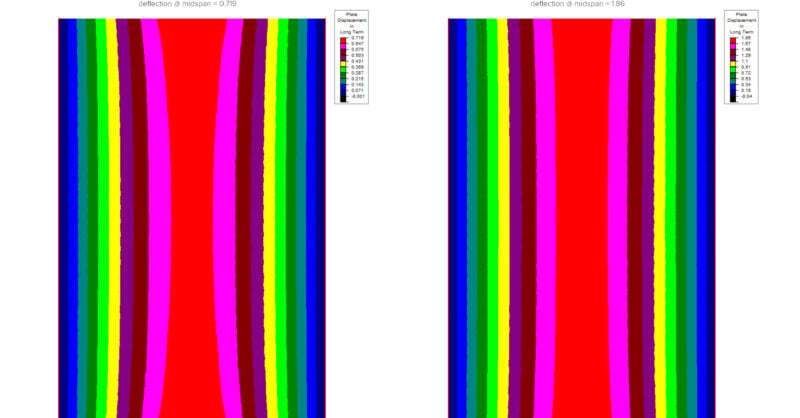
Why does my slab deflection increase using ACI 318-19?
Since the release of RISAFloor v15 and ADAPT-Builder v20, both which...
Key Takeaways
In structural engineering, the Area Moment of Inertia (I) is a geometrical property of a cross-section that describes how its mass or area is distributed relative to a central axis. It is the primary measure of a member's stiffness and its ability to resist bending and deflection.
Unlike total area (which simply tells you how much material you have), the moment of inertia tells you where that material is located. The farther the material sits from the neutral axis (the center of bending), the higher the moment of inertia becomes.
This is why an I-beam is so effective: it places the bulk of the material in the flanges, as far as possible from the center, to maximize resistance to bending.
To visualize moment of inertia, imagine a standard wooden 2 x 4 board used as a bridge across a small gap.
The amount of wood hasn't changed, but by moving the material farther away from the center of the board, you have drastically increased the Moment of Inertia. This is why structural steel is shaped into "I" or "H" beams; it places the bulk of the material (the flanges) as far as possible from the center (the neutral axis) to maximize stiffness with minimal weight.
Engineers rely on a set of standard formulas to determine the inertia of common shapes. The most important of these is the rectangular section, where the height of the member is cubed, highlighting why depth is the most critical factor in beam design.
The "bread and butter" of structural calculations:
For shapes like steel tubes or wide-flange beams, the calculation involves taking the "gross" outer rectangle and subtracting the "hollow" inner areas:
For columns or shafts, the area is distributed equally in all directions:
In a modern engineering workflow, calculating the moment of inertia for complex, unsymmetrical, or built-up sections by hand is a high-risk use of time. Software like RISA-3D or RISACalc automates these properties.
Concrete design adds a layer of complexity: cracking. When a concrete beam bends, the tension side cracks, effectively removing that area from the moment of inertia calculation.
For T-beams, L-shapes, or custom channels, the software utilizes the Parallel Axis Theorem to find the neutral axis (centroid) and then sums the inertia of each component. This ensures that even the most irregular architectural features are modeled with accurate stiffness.
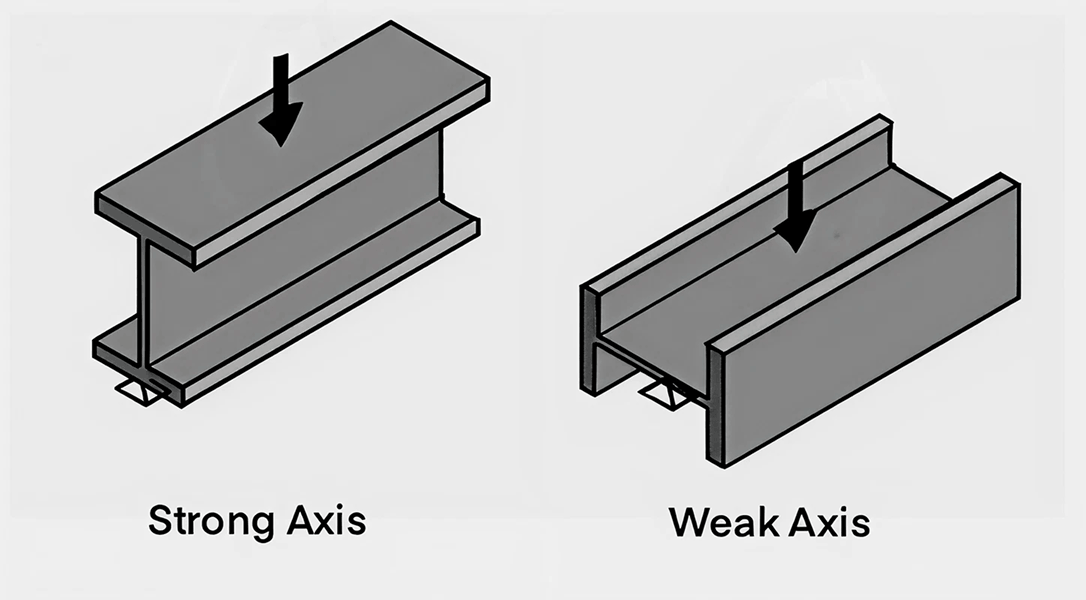
If your model is returning "Stability" errors or excessive deflections, the first thing to check is member orientation. A beam accidentally rotated 90° is bending about its weak axis, losing roughly 70-80% of its intended stiffness.
The moment of inertia is the tool that allows engineers to span longer distances and reach higher heights without simply "throwing more material" at the problem. When you understand how to manipulate cross-sectional geometry, you can optimize for both safety and economy.
Are you ready to stop the manual math and start optimizing? RISA handles the heavy lifting of section property analysis and code-compliant deflection checks so you can focus on the big picture.
Start your free trial of RISA-3D today and move from manual formulas to professional design automation.
Since the release of RISAFloor v15 and ADAPT-Builder v20, both which...
Industrial steel structures—such as pipe racks, material handling systems,...
The Quick Start Course is a 4-hour introduction to the basic features...